
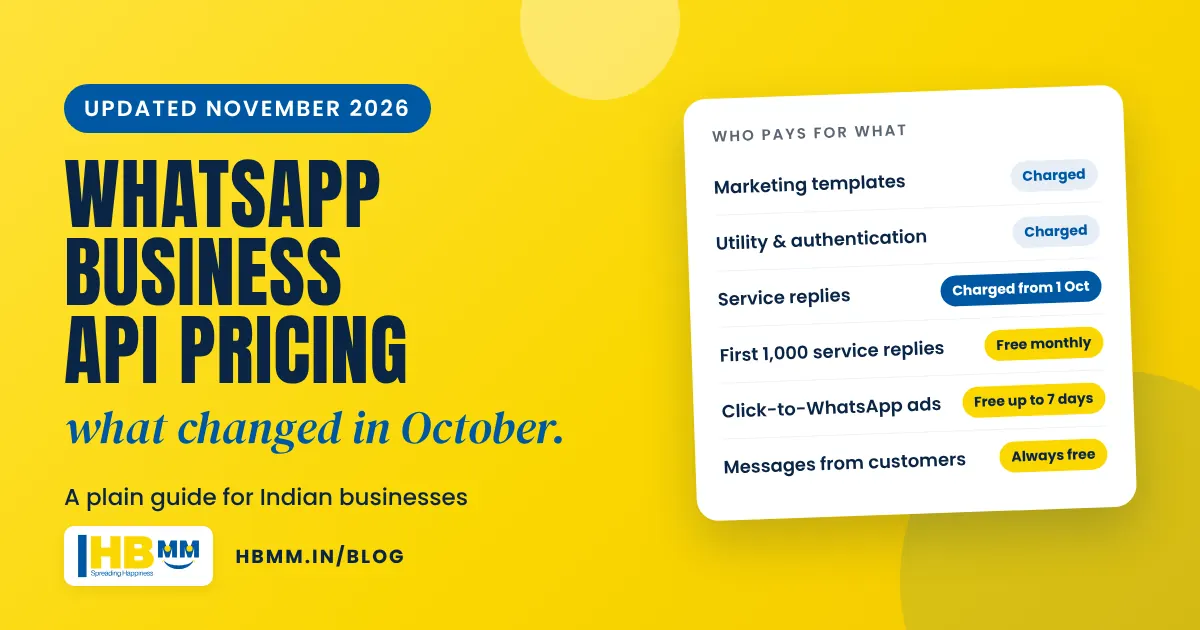
WhatsApp Business API pricing changed again on 1 October 2026. Meta now charges for the replies your team sends to customers (service messages), which had been free since November 2024, and for utility messages sent inside an open chat. At the same time, every business number gets 1,000 free service replies a month, and chats that start from a Click-to-WhatsApp ad still open a free window. If your business in Ahmedabad, Gujarat or anywhere in India uses the WhatsApp Business Platform for enquiries, orders or support, this guide explains what changed, what is still free and how to keep your monthly bill under control.
Short answer: Since 1 October 2026, Meta charges for every delivered business message on the WhatsApp Business Platform, per message and by category: marketing, utility, authentication, service, and the new Meta Business Agent (AI) category. Messages from customers are never charged. Each business phone number gets 1,000 free service replies per month, and replies to people who message you from a Click-to-WhatsApp ad open a free window of up to 7 days. Rates depend on the message category and the customer’s country, and Indian businesses can see rates in INR on Meta’s official rate card.
In this guide
- WhatsApp Business API pricing in 2026: the five message categories
- What changed on 1 October 2026
- What is still free on WhatsApp Business
- How Click-to-WhatsApp ads fit into the new pricing
- How to estimate your monthly WhatsApp bill (step by step)
- Seven ways to keep WhatsApp Business API costs under control
- Which businesses should care most?
- Frequently asked questions
WhatsApp Business API pricing in 2026: the five message categories
Meta has charged per delivered message (not per 24-hour conversation) since 1 July 2025. Every message your business sends falls into exactly one category, and each category has its own rate in each market. According to Meta’s official WhatsApp Business Platform pricing page, the categories are:
| Category | What it is used for | When charged |
|---|---|---|
| Marketing | Template messages that promote something: offers, launches, festive greetings, abandoned cart reminders | Yes, per delivered message |
| Utility | Template messages about an existing order or account: order confirmations, delivery updates, appointment reminders | Yes, including (since 1 October 2026) when sent inside an open chat |
| Authentication | One-time passwords and login codes | Yes, per delivered message |
| Service | Free-form replies to a customer, typed by your staff or sent by a third-party chatbot | Yes from 1 October 2026, after 1,000 free replies per number each month |
| Meta Business Agent | Replies written by Meta’s own AI agent platform | Yes since 1 August 2026, priced by AI tokens used |
Two rules sit underneath all of this. First, Meta only charges when a message is delivered, not when it is sent. Second, Meta does not charge for messages that customers send to you, so a busy inbox of incoming questions costs nothing by itself.
What changed on 1 October 2026
Meta’s pricing update notes list three changes in the second half of 2026:
- Service messages are charged again. Free-form replies inside the 24-hour customer service window had been free since 1 November 2024. From 1 October 2026 they are charged per message, at the same rate as utility and authentication messages for that market.
- Utility messages sent in an open chat are charged. These had been free since 1 July 2025. If you send an order update template while the customer is already chatting with you, it now counts.
- Meta Business Agent messages are charged by tokens. Since 1 August 2026, replies powered by Meta’s own AI agent cost one global rate of USD 2 per million tokens, which Meta estimates at roughly 4 to 5 US cents per message.
Meta also introduced a monthly free tier: each business phone number gets 1,000 delivered service messages free every month. Unused free messages do not carry over, and the count resets at midnight in your account’s time zone on the first of each month. One practical warning from Meta: if your messaging account has no payment method, service replies stop being delivered once the free 1,000 are used up.
What is still free on WhatsApp Business
- Every message a customer sends you. Meta only charges for business-to-customer messages.
- The first 1,000 service replies per number per month. A small clinic, showroom or B2B supplier that answers a few dozen enquiries a day may stay inside this.
- Chats that start from a Click-to-WhatsApp ad. When someone taps your Facebook or Instagram ad and messages you from the WhatsApp mobile app, and you reply within 24 hours, that reply is free and opens a free entry point window that can stay open for up to 7 days. Marketing, utility, authentication and service messages in that window are not charged (Meta Business Agent messages still are).
- Undelivered messages. If a message is not delivered, there is no charge.
These charges apply to the WhatsApp Business Platform, which is what you use through Cloud API, a solution provider or a chatbot tool. The free WhatsApp Business app on a single phone works differently, but it has limits on team use, automation and integrations, which is why growing businesses move to the platform.
How Click-to-WhatsApp ads fit into the new pricing
For many Indian businesses, the free entry point window is now the strongest reason to run Click-to-WhatsApp ads on Facebook and Instagram. You pay Meta for the ad, but the conversation that follows (product photos, a catalogue, an order confirmation, a follow-up the next day) can cost nothing in message fees while the window is open.
A few details matter:
- The customer must message you from the WhatsApp app on Android or iPhone. Desktop and web do not open the free window.
- You must reply within the 24-hour customer service window. Slow replies lose the benefit, so set up alerts or a simple auto-reply that hands over to a person.
- The free window is tracked per business and customer pair, so several team members or tools on the same number share it.
If you already run Meta ads that send people to a website form, it is worth testing a Click-to-WhatsApp version side by side. Our social media marketing team sets these up with clear audiences, creatives and reply scripts.
How to estimate your monthly WhatsApp bill (step by step)
You do not need exact rates to plan. Use this simple method, then plug in the INR rates from Meta’s official rate card:
- Count your replies. How many free-form replies does your team send per month on each WhatsApp number? Subtract 1,000 for the free tier.
- Count your templates by category. Order and delivery updates are utility; offers and greetings are marketing; OTPs are authentication.
- Separate ad-led chats. Messages sent inside a Click-to-WhatsApp free window are not charged, so remove them from the count.
- Check where your customers are. Rates depend on the customer’s country code. Exporters messaging buyers abroad pay that market’s rate, not India’s.
- Add your provider’s fee. Most solution providers and chatbot tools charge their own subscription or markup on top of Meta’s rates.
- Review monthly. Meta can update rates up to once a quarter, per its published pricing calendar.
Seven ways to keep WhatsApp Business API costs under control
| Action | Why it helps |
|---|---|
| Answer more in fewer messages | Every delivered service message now counts after the free tier. One clear reply with price range, photos link and next step beats five short ones. |
| Use Click-to-WhatsApp ads for new enquiries | The free entry point window covers the follow-up conversation for up to 7 days. |
| Categorise templates honestly | Meta reviews template categories. A “utility” template with promotional wording can be treated as marketing, which usually costs more. |
| Send marketing only to opted-in, interested customers | Broadcasts to cold lists waste money and invite blocks and reports, which hurt your number’s quality. |
| Move FAQs to your website | Link to a clear FAQ, product or service page instead of typing the same answers again and again. |
| Compare AI options before switching on a bot | Meta Business Agent is charged per token; third-party AI tools charge separately for AI plus message delivery. Test both on real conversations. |
| Track enquiries, not just messages | Measure how many chats turn into quotes and orders, so you know which campaigns are worth the message cost. |
Which businesses should care most?
D2C and ecommerce brands sending order confirmations, delivery updates and support replies will see utility and service messages add up fastest. Our ecommerce and D2C work often combines WhatsApp updates with a faster checkout on the website so fewer customers need to ask “where is my order?”.
Clinics, hospitals and diagnostic centres rely on appointment reminders and reports. Keep reminders as true utility templates and keep marketing separate. See our work for healthcare and pharma.
Manufacturers and exporters often chat with buyers in other countries, so the customer’s market decides the rate. A detailed product page or catalogue link answers technical questions in one message instead of ten.
Real estate developers and showrooms get many enquiries from ads. Click-to-WhatsApp ads plus a fast first reply keep most of the early conversation inside the free window.

Frequently asked questions
Is the WhatsApp Business API free in India? No. Meta charges per delivered business message, with rates set by message category and the customer’s country. Customer messages are free, each number gets 1,000 free service replies per month, and chats from Click-to-WhatsApp ads open a free window of up to 7 days.
When did WhatsApp start charging for service messages again? On 1 October 2026. Service messages had been free since 1 November 2024. Utility messages sent within an open chat also became chargeable on the same date.
Where can I see the official WhatsApp Business API rates in INR? On Meta’s pricing page for the WhatsApp Business Platform, which links to rate cards in several currencies including INR, and on the WhatsApp Business website. Your solution provider may add its own fee.
Does the 1,000 free messages limit apply per account or per number? Per business phone number, per month. Unused free messages do not roll over.
Is Click-to-WhatsApp always free? The ad itself is paid. The messages you send after the customer contacts you from the ad are free inside the free entry point window, as long as you reply within 24 hours and the customer used the WhatsApp mobile app. Meta Business Agent replies are still charged.
How HB Multimedia can help
HB Multimedia has helped businesses market themselves since 2008 from our office in Naranpura, Ahmedabad, in English, Hindi and Gujarati. If WhatsApp is where your enquiries arrive, our WhatsApp automation and chatbot service can set up the platform, write honest template categories, build quick-reply flows and connect Click-to-WhatsApp ads, while our digital marketing agency in Ahmedabad plans the campaigns that bring the chats in. Get a free proposal or talk to us on WhatsApp.