
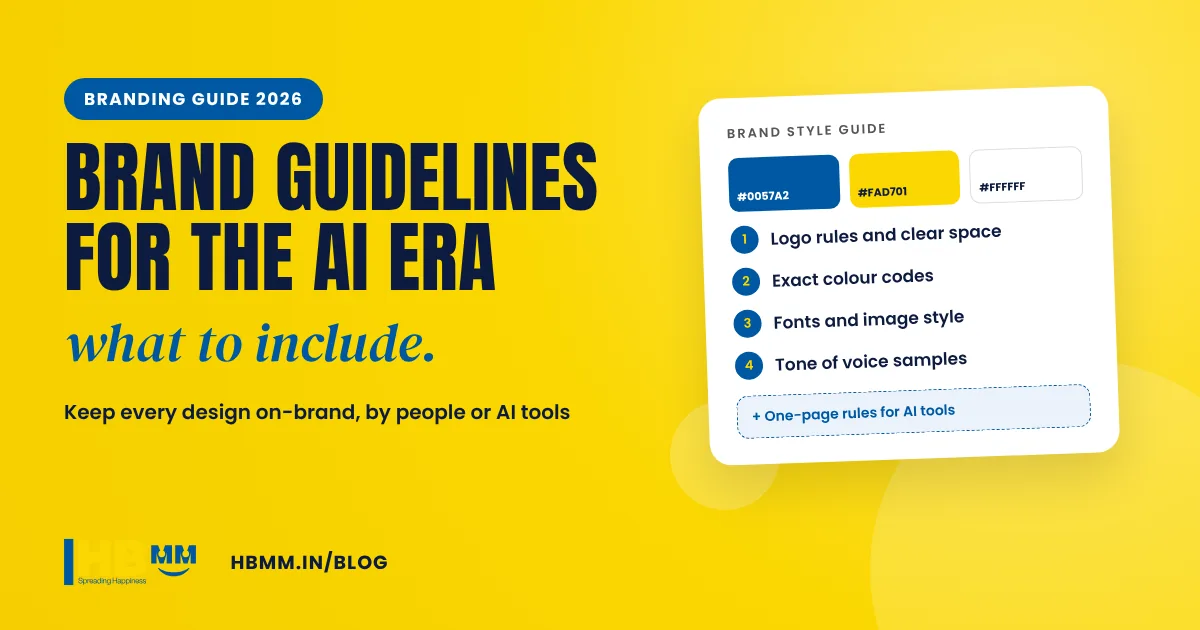
Brand guidelines used to be a PDF that sat in a shared folder until a new designer joined. In 2026 that has changed. More of your posters, social posts, presentations and product images are now drafted by AI tools, and those tools only stay on-brand if you give them clear rules. On 10 November 2026, at Adobe MAX, Adobe announced that its new Creative Agent in Firefly lets teams “set formats, colors, brand guidelines, characters and products once and apply them across every project”. Canva, Microsoft and others are moving the same way. This guide explains what brand guidelines should include now, how to write them so both people and AI tools can follow them, and a simple checklist for businesses in Ahmedabad, Gujarat and across India.
Short answer: Brand guidelines (also called a brand style guide) are the written rules for how your brand looks and sounds: logo use, colours with exact codes, fonts, image style, layouts, tone of voice and approved words. In the AI era they need to be more precise than before: exact HEX, RGB and CMYK values, named fonts with fallbacks, clear do and don’t examples, sample sentences in your voice, and a short “rules for AI tools” page you can paste into or upload to the tools your team uses. A good set is 15 to 40 pages, plus a one-page summary.
In this guide
- What changed in 2026: why brand guidelines matter more with AI
- What to include in brand guidelines: the core sections
- How to write brand guidelines that AI tools can follow
- Brand guidelines checklist for Indian businesses
- Brand guidelines template: a simple structure
- Common mistakes with brand guidelines
- Brand style guide vs brand guidelines: is there a difference?
- Frequently asked questions
What changed in 2026: why brand guidelines matter more with AI
Until recently, only a trained designer touched your logo and layouts. Now a sales manager can ask an AI tool for a WhatsApp banner, and a marketing intern can generate twenty social posts in an hour. That speed is useful, but every one of those designs is a chance for your brand to drift: the wrong blue, a stretched logo, a font that looks almost right, or copy that sounds nothing like you.
The design software makers are building for this. In its Firefly announcement of 10 November 2026, Adobe described customisation settings in its Creative Agent for brand guidelines, colours and products, and a beta tool called Firefly Graph for “scaling brand guidelines across campaign assets”. In a second announcement the same day, Adobe said its Brand Intelligence agent, which “continuously learns and enforces brand standards”, is coming to Photoshop, Illustrator and InDesign. Many of these features are in beta and aimed at larger teams, but the direction is clear: AI tools will increasingly read your brand guidelines and apply them for you.
That only works if your guidelines are written down, specific and up to date. Vague rules such as “use our blue” or “keep it modern” mean nothing to a person in a hurry, and even less to software.
What to include in brand guidelines: the core sections
Whether you call it a brand book, brand manual or brand style guide, the sections are much the same. Here is what to include in brand guidelines, and what each section should state.
| Section | What it should state | What AI tools need from it |
|---|---|---|
| Brand foundations | What you do, for whom, your promise and three to five values | A two-line description of the business to paste into prompts |
| Logo | Main logo, versions (horizontal, stacked, icon), clear space, minimum size, wrong uses | Approved logo files only; a rule that AI must never redraw or recolour the logo |
| Colours | Primary and secondary colours with HEX, RGB, CMYK and Pantone values, and how much of each to use | Exact HEX codes and a ratio, for example “70% white, 20% blue, 10% yellow” |
| Typography | Heading and body fonts, weights, sizes, fallbacks for Hindi and Gujarati | Font names exactly as they appear in the tool, plus a safe fallback |
| Imagery | Photo style, lighting, people, backgrounds, illustration and icon style | Five to ten approved reference images and a list of styles to avoid |
| Layouts and templates | Grids, margins, social post and presentation templates, print sizes | Ready templates so AI fills content into a fixed design |
| Tone of voice | How you sound, words you use and avoid, language choices (English, Hindi, Gujarati) | Sample sentences and a banned-words list |
| Legal and usage | Trademark notes, image rights, who approves what | A rule against using people’s faces or copyrighted work without permission |
If you are still building the visual identity itself, start with our brand identity checklist, which covers the full kit of assets. Brand guidelines are the rulebook that tells everyone how to use that kit.
How to write brand guidelines that AI tools can follow
People read brand guidelines visually; AI tools read them literally. These steps make your brand style guide work for both.
- Replace adjectives with numbers. Instead of “plenty of space around the logo”, write “clear space equal to the height of the letter H on all sides”. Instead of “our blue”, write “#0057A2”.
- Show do and don’t examples side by side. One image of a correct social post next to one with a stretched logo or wrong colour teaches faster than a paragraph.
- Write a one-page “rules for AI tools” summary. Brand description, colour codes, fonts, image style in one sentence, tone in three words, and five hard rules. This is the page your team pastes into a chat tool or saves as a custom instruction.
- Lock the logo. State that the logo must always be placed from the approved file and never generated, redrawn or restyled by AI. Image generators often produce near-copies that look wrong at a glance.
- Give sample copy in your voice. Three example headlines, three example captions and a sample WhatsApp reply show tone far better than “friendly but professional”.
- Include regional language rules. If you post in Gujarati or Hindi, name the fonts, say whether you mix scripts, and list product terms that must stay in English.
- Build templates, not just rules. Ready templates for posts, stories, presentations and brochures mean AI fills in content while the layout stays fixed.
- Name an owner and a review date. One person approves new templates and updates the guide, reviewed every six to twelve months.
Brand guidelines checklist for Indian businesses
Use this checklist to see whether your current brand guidelines are ready for day-to-day use and for AI tools.
- Logo files in vector (AI, SVG or PDF) and PNG, in colour, black and white versions
- Exact colour codes for screen (HEX, RGB) and print (CMYK, Pantone)
- Font names, weights and licences, with Hindi and Gujarati fonts if you use them
- Photo and illustration style, with approved reference images
- Templates for social posts, reels covers, presentations, letterheads and visiting cards
- Tone of voice with sample headlines, captions and replies
- A one-page brand summary for staff, vendors and AI tools
- Packaging, signage and vehicle rules if they apply to your business
- Website rules: button colours, heading styles and image sizes
- Who approves new designs, and the date of the last update
Manufacturers and exporters should add rules for catalogues, product labels and exhibition stalls. Clinics and hospitals need clear rules for patient-facing material. Builders need rules for site hoardings and project brochures. Our manufacturing and engineering and real estate and construction pages show what we usually build for those sectors.

Brand guidelines template: a simple structure
If you are writing your own, this brand guidelines template gives a sensible order. Small businesses can cover it in 15 to 20 pages; larger brands with many products may need 40 or more.
- Cover and contents
- About the brand: story, promise, values, audience
- Logo: versions, clear space, minimum sizes, wrong uses
- Colour palette with codes and proportions
- Typography for English, Hindi and Gujarati
- Imagery, icons and illustration
- Layout grids and templates
- Tone of voice and sample copy
- Applications: stationery, social media, website, packaging, signage
- Rules for AI tools (the one-page summary)
- Contacts, file locations and version history
Common mistakes with brand guidelines
- Writing a beautiful PDF that nobody can find; keep it in one shared place with the logo files and templates
- Listing colours without codes, so every printer and designer guesses
- Choosing fonts the team cannot use in the tools they work in every day
- No rules for social media, where most brand drift happens
- Letting AI tools generate logos, icons or “similar” versions of your mark
- Never updating the guide after a new product, website or packaging range
Brand style guide vs brand guidelines: is there a difference?
In practice, no. “Brand guidelines”, “brand style guide”, “brand manual” and “brand book” are used for the same document. Some agencies use “style guide” for a shorter visual-only version and “brand guidelines” for the full document including strategy and tone of voice. What matters is that it covers your logo, colours, fonts, imagery, layouts and voice, and that people and tools actually use it.
Frequently asked questions
What are brand guidelines? Brand guidelines are a document that sets out how your brand should look and sound everywhere: logo use, colours, fonts, images, layouts and tone of voice. They keep every design, post and document consistent, whoever makes it.
How long should brand guidelines be? Most small and medium businesses need 15 to 40 pages, plus a one-page summary. Length matters less than clarity: exact codes, clear examples and ready templates.
Can AI tools follow my brand guidelines? Increasingly, yes. Tools such as Adobe Firefly let teams save brand settings, and most chat tools accept custom instructions. They work best with precise rules (colour codes, font names, sample copy) and approved files, and every AI-made design should still be checked by a person before it goes out.
Should I let AI design my logo? We do not recommend it for your main brand mark. AI image tools can produce marks that look like existing logos, are hard to protect and do not scale cleanly. Our guide to the logo design process explains what a proper logo project should give you.
How often should brand guidelines be updated? Review them every six to twelve months, and whenever you launch a new product, website, packaging range or campaign style.
How HB Multimedia can help
HB Multimedia has designed brands from our office in Naranpura, Ahmedabad since 2008, with more than 10,000 projects completed for over 4,500 clients. Our branding team can audit your current logo, colours and materials, write clear brand guidelines with a one-page summary for AI tools, and build ready templates for social media, presentations and print through our graphic design and AI design services. We work in English, Hindi and Gujarati. Get a free proposal or talk to us on WhatsApp.