
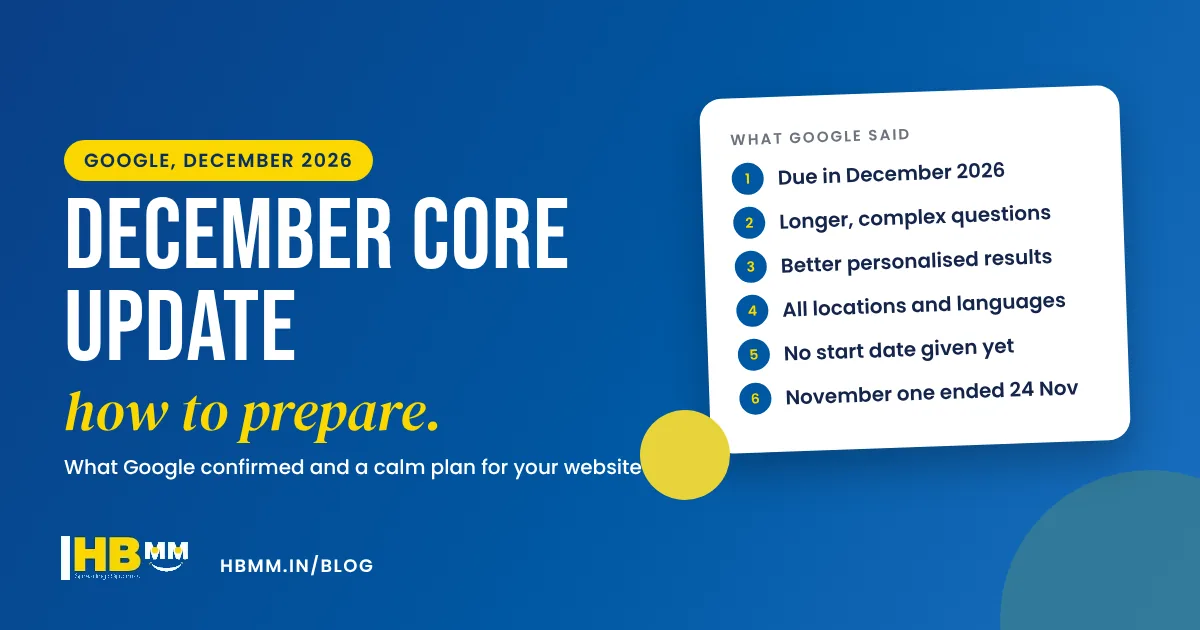
The Google December 2026 core update has been announced before it has even started. On 24 November 2026, the same day the November core update finished rolling out, Google posted a notice on its Search Status Dashboard saying another core update is scheduled for December 2026. That leaves business websites with two big ranking changes in roughly six weeks. This guide explains exactly what Google has said, what the two areas it named (longer, more complex questions and personalised results) could mean for your pages, and a calm plan to prepare, whether you run a manufacturing company in Ahmedabad, a clinic in Gujarat or an online store selling across India.
Short answer: Google preannounced the December 2026 core update on 24 November 2026. Google says it improves how its systems understand and rank relevant content, including for longer and more complex questions, and improves personalised results for people who have personalisation turned on. It applies to all locations and languages, and no start date or rollout length has been given yet. The best preparation is to review what the November update changed, strengthen the pages that answer your customers’ detailed questions, keep your business details consistent, and avoid big site changes while the update rolls out.
In this guide
- What Google has confirmed about the Google December 2026 core update
- Why Google is announcing core updates in advance
- What “longer and more complex questions” could mean for your website
- What “improving personalised results” means
- How to prepare for the December 2026 core update: a 7-step plan
- What not to do before the update
- Will the December core update affect AI Overviews and AI Mode?
- Frequently asked questions
What Google has confirmed about the Google December 2026 core update
The announcement is a single entry on the Google Search Status Dashboard, posted at 7:03 am US Pacific time on 24 November 2026 (about 8:33 pm in India). In Google’s words, the update “focuses on multiple improvements to how our systems understand and rank relevant content (including for longer and more complex questions), as well as improving personalized results for people who have personalization turned on.” Here is everything confirmed so far:
| Detail | What Google said |
|---|---|
| Announced | 24 November 2026, 7:03 am US Pacific (about 8:33 pm IST) |
| Release | “Scheduled to be released in December 2026” |
| Start date and length | Not given yet. Google will post the start on the same dashboard |
| Focus | Understanding and ranking relevant content, including for longer and more complex questions |
| Personalisation | Improves personalised results for people who have personalisation turned on |
| Where it applies | All locations and languages where Google Search is available, so India is included |
| Guidance | Google’s general guidance about core updates applies |
Anything beyond this table, such as an exact start date, is guesswork at the time of writing. We will update this guide when Google posts the rollout start and completion.
The November 2026 core update has finished
The previous update, covered in our guide to the Google core update November 2026, started on 10 November at 10:06 am Pacific time. Google marked it complete on 24 November 2026 at 6:03 am Pacific time, saying “The rollout was complete as of November 24, 2026.” That is a rollout of about 14 days, in line with the “up to 2 weeks” Google gave at the start. The December notice appeared about an hour later.
Why Google is announcing core updates in advance
Until now, Google usually announced a core update on the day it started. On 24 November 2026 Google also published a new Search Central page, How to stay informed on Google Search ranking updates, which explains when it gives advance notice. According to that page, Google pre-announces changes that introduce “actionable policy requirements” or “may cause broad ranking shifts for site owners”, and core updates are given as an example of the second kind.
The page also says that for changes where UK users may see a significant ranking shift, Google gives advance notice “in accordance with CMA’s fair ranking conduct requirements for Google”. The CMA is the UK’s competition regulator. Whatever the reason, the result is useful for businesses everywhere, including India: you now get time to prepare instead of finding out after your traffic has already moved.
The same page sets out where to watch for news. Google publishes pre-announcements, rollout start dates and completion notices on the Search Status Dashboard, which also has an RSS feed you can follow.
What “longer and more complex questions” could mean for your website
Google has not explained the technical changes, so treat this section as our practical reading, not a description of how the algorithm works. People increasingly type or speak full questions into Google, especially since AI Overviews and AI Mode encourage conversational searches. Instead of “packaging design Ahmedabad”, a buyer might search “how long does packaging design take for a new spice brand and what files will I get for printing”. If Google gets better at matching those detailed questions with pages that genuinely answer them, pages with specific, well-organised answers stand to benefit.
For a typical business website, that points to a few habits:
- Answer real questions on the page. Collect the questions customers ask on calls, on WhatsApp and at exhibitions, and answer them in plain language on the relevant service or product page.
- Cover the details, not just the headline. A manufacturer’s product page that lists grades, sizes, tolerances, certifications, minimum order quantities and the industries it serves answers far more complex questions than a page with one paragraph and a photo.
- Use clear headings. Headings that match the way people ask questions (“Which material is best for outdoor signage?”) help both readers and search systems find the right part of a long page.
- Explain trade-offs and conditions. Complex questions usually contain “if”, “for” or “versus”. Pages that compare options honestly (when a WordPress site is enough, when you need a custom build) are naturally better matches.

What “improving personalised results” means
Google says the December update improves personalised results “for people who have personalization turned on”. Personalisation is a setting in a person’s Google account and search settings, so it only affects people who have it switched on. Google has not said how it will change, so this is our reading, not a confirmed mechanism.
Personalised results generally lean on what someone has searched for, visited or engaged with before. For a business, the practical lesson is that familiarity matters. People who already know your brand, have visited your website, follow your YouTube channel or have read your guides are the people most likely to see you again. That makes the basics more valuable than ever:
- A memorable, consistent brand name across your website, Google Business Profile and social profiles
- Useful content that brings people back, such as guides, checklists and short videos
- A website that is pleasant to use on a phone, so a first visit is not the last one
- Regular email or WhatsApp updates to existing customers, so they search for you by name
How to prepare for the December 2026 core update: a 7-step plan
You do not need to rebuild your website before December. You do need clean data and a short list of pages to improve. Here is the plan we follow for clients:
- Write down the key dates. November update: 10 to 24 November 2026. December update: preannounced 24 November, start date to be confirmed. You will need these to read your data correctly later.
- Wait a week, then review November. Google’s new page advises waiting until an update is marked complete “plus at least a week of post-rollout data” before evaluating traffic changes. For the November update that means looking from about 1 December onwards.
- Find the pages that moved. In Search Console, open Performance, compare a week after 24 November with a week before 10 November, and sort the Pages tab by change in clicks. Note the winners as well as the losers.
- Collect your customers’ detailed questions. Ask your sales team for the ten questions they hear most often. Check which ones your website answers clearly, and which it does not answer at all.
- Improve your most valuable pages first. Start with the pages that bring enquiries: home page, main service or product pages and any guides that get clicks. Add direct answers, specific details, real photos and clear next steps.
- Check trust and consistency. Your business name, address, phone number and opening hours should match on your website, Google Business Profile and directories. Our local SEO checklist covers each step.
- Freeze big changes once the rollout starts. When Google posts the December start date, avoid redesigns, URL changes or mass deletions until it finishes, so you can tell what caused any movement.
Reading your data when two updates are close together
With two core updates back to back, it is easy to blame the wrong one. Use separate comparison windows:
| To measure | Compare | Notes |
|---|---|---|
| November update | A week before 10 Nov vs a week starting around 1 Dec | Only clean if the December update has not started yet |
| December update | A week before its start date vs a week after it completes, plus a few days | Dates to be confirmed on the Search Status Dashboard |
| Seasonal effects | Same weeks last year | Black Friday, year-end holidays and wedding season can move traffic on their own |
If the December update starts early in the month, the clean window for judging November will be short. In that case, focus on clear, large movements and do not over-read small day-to-day changes.
What not to do before the update
- Do not rewrite every page on the site in one go. Improve the pages that matter, one at a time.
- Do not stuff pages with long-tail phrases to “match complex questions”. Answer the questions properly instead.
- Do not publish dozens of thin AI-written articles in the hope of catching more searches.
- Do not buy links or “guaranteed ranking” packages. No one can guarantee how a core update will treat a website.
- Do not change URLs or delete pages without a plan. If a redesign is unavoidable, follow a website redesign checklist and set up 301 redirects.
Will the December core update affect AI Overviews and AI Mode?
Google’s notice does not mention AI Overviews or AI Mode. The focus on longer, more complex questions does overlap with the way people use those features, and Google’s AI features draw on its search index and ranking systems. The safe approach is the same for both: clear answers, well-structured pages and consistent business information. Our guides to getting recommended by ChatGPT and AI Overviews and generative engine optimisation go into more detail.
You can also measure it. The Search Console generative AI report shows how often your pages appear in AI Overviews and AI Mode, so you can compare before and after each update in the same way as normal search.

Frequently asked questions
When will the Google December 2026 core update start? Google has only said it is scheduled for release in December 2026. No start date or rollout length has been announced. Google will post the start on the Search Status Dashboard.
What is the December 2026 core update about? Google says it improves how its systems understand and rank relevant content, including for longer and more complex questions, and improves personalised results for people who have personalisation turned on.
Is the November 2026 core update finished? Yes. Google marked it complete on 24 November 2026, about two weeks after it started on 10 November.
Should I make changes to my website before the update? Yes, if they are genuine improvements to important pages, such as clearer answers and better details. Avoid big redesigns or URL changes during the rollout itself.
Can an SEO company protect my rankings from the core update? No one can guarantee rankings. A good SEO partner reads your data honestly, improves the pages that matter and explains what changed after each update.
How HB Multimedia can help
HB Multimedia has built and marketed business websites since 2008 from our office in Naranpura, Ahmedabad, with more than 10,000 projects completed for over 4,500 clients. Before the December 2026 core update, our SEO services in Ahmedabad can review what the November update changed for your site, list the pages worth improving first and rewrite them to answer your customers’ real questions. For visibility in AI Overviews, AI Mode and ChatGPT, see our AI SEO and GEO service. Get a free proposal or talk to us on WhatsApp.