
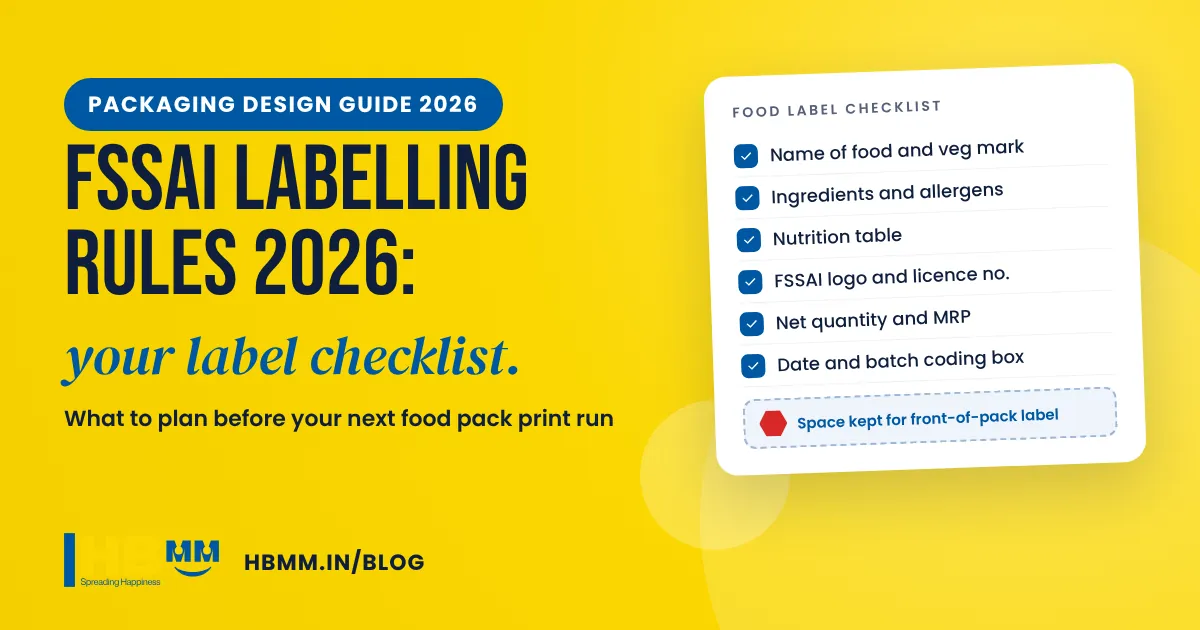
FSSAI labelling rules 2026 matter to every food brand that is planning a new pack, a redesign or simply its next print run. In March 2026 FSSAI notified an amendment to the Food Safety and Standards (Labelling and Display) Regulations, 2020, and in September 2026 it proposed a front-of-pack warning label for foods high in sugar, salt or fat. Neither change is a reason to panic, but both are a good reason to review your label artwork now rather than after you have printed a year of stock. This guide explains what changed, what is still only a proposal, and gives a practical food packaging design checklist for brands in Ahmedabad, Gujarat and across India.
Short answer: the FSSAI labelling rules 2026 are the Food Safety and Standards (Labelling and Display) First Amendment Regulations, 2026, which legal summaries say come into force on 1 July 2027. They clarify rules for minimally processed foods, small packs (up to 100 cm²), non-retail containers, fortified foods and products with artificial sweeteners, and say mandatory information must be clear, legible and durable. Separately, FSSAI has proposed (not yet finalised) a red front-of-pack warning for foods high in sugar, salt or fat. For designers, the practical step is to plan one master label layout with space for every mandatory declaration and a reserved front-of-pack area, and to have the final artwork checked by your food regulatory consultant before printing.
In this guide
- What the FSSAI labelling rules 2026 actually change
- Front-of-pack labelling in India: what is proposed
- Food label design checklist: what usually has to be on the pack
- How to redesign a food label for the 2026 rules: 7 steps
- Packaging design tips that work within the rules
- Packaging design checklist before you approve artwork
- Who should act now
- Frequently asked questions
Please note: this article is a design guide, not legal advice. Regulations and their dates change, so always confirm the current text on the FSSAI Gazette notifications page or with a qualified food regulatory professional before you print.
What the FSSAI labelling rules 2026 actually change
The base rulebook is still the FSS (Labelling and Display) Regulations, 2020. The 2026 First Amendment adjusts it rather than replacing it. Based on published legal summaries of the notification, the main points that affect packaging design are:
- Minimally processed foods: a clearer definition for foods such as cereals, pulses, fruits and vegetables that are only cleaned, ground, frozen, fermented or pasteurised. This affects which nutrition and labelling requirements apply to simple single-ingredient products.
- Small packs: packs with a surface area of up to 100 cm² are reported to be exempt from showing the FSSAI logo, provided the required information appears on the multi-unit pack they are sold in. Sachets and small pouches are where this matters most.
- Non-retail containers: bulk packs must carry key details such as the product name, licence number, batch and manufacturer details, and be clearly marked as not for direct sale to consumers.
- Legibility: mandatory information must be clear, visible, legible and durable. In practice, tiny grey text on a glossy pouch or details printed over a busy photo are now a bigger risk.
- Fortified foods and sweeteners: fortified products use the “Fortified with” statement and the prescribed logo, and products with specified artificial sweeteners need the prescribed warnings.
Most summaries give a compliance date of 1 July 2027. Food packaging is printed in large runs, so a label approved in early 2027 may still be on shelves after that date.
Front-of-pack labelling in India: what is proposed
The bigger visual change is front-of-pack nutrition labelling. As Business Standard reported on 23 September 2026, FSSAI told the Supreme Court it proposes a single-phase rollout: finalise draft regulations within about four months, hold the usual public and WTO consultation, and then allow a 365-day voluntary compliance window so brands can use up existing printed stock.
The proposed design, as reported, is a red hexagon on a white square in the top-left corner of the front of pack, naming the nutrient of concern, for example “high sugar”, “high salt” or “high fat”. The text is proposed to be at least one point larger than the nutrition table on the back. Single-ingredient foods and items such as ghee, edible oil, salt, sugar, jaggery and honey are reported to be exempt.
This is still a proposal, and the final format, thresholds and dates may change after consultation. For a designer, though, the direction is clear: the top-left of the front panel may not stay free for your logo or hero claim. If you are redesigning now, keep that zone flexible.

Food label design checklist: what usually has to be on the pack
Indian food packs have to satisfy two sets of rules: FSSAI’s labelling regulations and the Legal Metrology (Packaged Commodities) Rules, 2011, which cover declarations such as net quantity and MRP. The table below lists the declarations most packaged foods need, where they usually sit, and a design tip for each. Exact requirements vary by product category and pack size, so treat it as a planning list for your designer and consultant.
| Label element | Where it usually sits | Design tip |
|---|---|---|
| Name of the food (and its true nature) | Front panel | Keep the descriptive name close to the brand name, not hidden in small print. |
| Veg or non-veg symbol | Front panel, near the name | Use the exact prescribed symbol and colours; never recolour it to match your palette. |
| Ingredients list and allergen declaration | Back or side panel | Allow enough width so the list does not wrap into a dense block; make allergens easy to spot. |
| Nutrition information table | Back panel | Use a plain table on a solid background; avoid printing it over photos or gradients. |
| FSSAI logo and licence number | Back panel, near the manufacturer details | Reserve a fixed slot so it does not move between pack sizes. |
| Name and address of manufacturer, packer or marketer | Back panel | Plan for long Indian addresses and multiple units (“manufactured by / marketed by”). |
| Net quantity, MRP (inclusive of all taxes) and unit sale price | Front for net quantity, back or side for MRP | Leave a clear, unvarnished area if MRP or dates are printed later on the line. |
| Date marking, batch or lot number | Top, bottom or a back panel window | Design a blank box for inkjet or laser coding so it never lands on artwork. |
| Consumer care details | Back panel | Phone, email and address in a consistent block across your range. |
| Instructions for use and storage | Back panel | Icons help, but keep the text version too. |
| Country of origin (imported foods) | Back panel | Importers should plan a sticker area that does not cover mandatory text. |
How to redesign a food label for the 2026 rules: 7 steps
- Collect every current pack and dieline. List each SKU, pack size and material. Small sachets and non-retail cartons often get forgotten.
- Ask your consultant for a declaration list per SKU. Your food regulatory consultant or quality team should confirm what each product must declare, including claims, allergens, fortification and any sweetener warnings.
- Build one master label system. Create a fixed grid for the back panel (ingredients, nutrition table, FSSAI block, manufacturer, MRP, coding box) and reuse it on every pack. This saves design time and reduces errors when you launch new flavours.
- Reserve the front-of-pack warning zone. Keep the top-left of the front panel free of critical branding, so that if the front-of-pack warning is finalised you only add it rather than redesign the whole pack.
- Check legibility on the real material. Print a proof on the actual pouch, carton or label stock. Check small text in shop lighting, on curved surfaces and after folding.
- Review claims and wording. Words such as “natural”, “fresh”, “pure” and “100%” are regulated. FSSAI has cautioned brands against unqualified “100%” claims, so let your consultant approve every claim before artwork is final.
- Update your digital copies too. Marketplaces such as Amazon, Flipkart, Blinkit and your own Shopify or WooCommerce store show label images. Refresh product photos and listing images when the label changes, so online and shelf packs match.
Packaging design tips that work within the rules
Compliance does not have to make a pack look crowded. Strong food packaging design treats the mandatory information as part of the layout from the first sketch, not as text squeezed in at the end.
- Give the front panel one job. Brand, product name, the key benefit and the veg or non-veg mark. Everything else can move to the back.
- Use a consistent back-panel template across the range. Customers learn where to look, and your printer makes fewer mistakes.
- Choose type for small sizes. Simple sans-serif fonts with open letters stay readable at small sizes; thin or condensed fonts do not.
- Keep contrast high. Dark text on a light, solid panel is the safest choice for mandatory information, especially on metallic or transparent films.
- Design for shelf and screen. Most shoppers now see your pack as a small thumbnail on a quick-commerce app before they ever hold it. Test the front at thumbnail size.
Packaging design checklist before you approve artwork
- Every mandatory declaration for this SKU is present and confirmed by your consultant.
- The veg or non-veg symbol uses the prescribed design and is near the product name.
- Allergens are clearly declared and easy to find.
- The nutrition table sits on a plain background and is readable on the printed proof.
- FSSAI logo and licence number are correct for this manufacturing unit.
- Net quantity, MRP and unit sale price follow Legal Metrology rules.
- A clear box is left for batch, date and MRP coding.
- The top-left of the front panel can take a future front-of-pack warning.
- Every claim (“natural”, “no added sugar”, “100%”) has been approved.
- Product photos and marketplace images have been updated to match the new pack.
Who should act now
If you make snacks, namkeen, sweets, beverages, sauces, spices, ready-to-eat meals or health foods, especially products with added sugar, salt or fat, start planning your label update in your next design cycle. D2C food brands selling online should also plan new product photography when the pack changes. If your products are mainly single-ingredient foods such as flour, pulses or spices, the changes may be smaller, but the legibility and small-pack rules still apply.
You can read more about planning a full brand system in our brand identity checklist and our guide to brand guidelines. Food businesses can also see how we work with food and hospitality brands and ecommerce and D2C brands.
Frequently asked questions
What are the FSSAI labelling rules 2026? They are the Food Safety and Standards (Labelling and Display) First Amendment Regulations, 2026, which amend the 2020 labelling regulations. Published legal summaries say they cover minimally processed foods, small packs, non-retail containers, fortified foods, sweetener warnings and legibility, and come into force on 1 July 2027.
Is front-of-pack labelling mandatory in India now? Not yet. FSSAI has proposed a red front-of-pack warning for foods high in sugar, salt or fat, and reported plans include a consultation and a 365-day voluntary window. Watch for the final notification before changing your front panel.
Do I need to reprint all my packaging immediately? Usually not. Plan the changes into your next print run and use the time before the compliance date to update artwork. Your regulatory consultant can confirm the deadline for each product.
Can a design agency make my label FSSAI compliant? A design agency lays out the label and makes sure every declaration fits, is legible and prints correctly. Whether the content is compliant should be confirmed by your food technologist or regulatory consultant. The best results come from both working together.
How HB Multimedia can help
HB Multimedia has designed brands, labels and packaging since 2008 from our office in Naranpura, Ahmedabad, with more than 10,000 projects completed for over 4,500 clients. Our packaging design team can build a master label system for your range, lay out every declaration your consultant confirms, reserve space for front-of-pack labelling and prepare print-ready files for your printer. Our product photography team can then shoot the new packs for your website and marketplaces, and our branding team can add the label rules to your brand guidelines. Get a free proposal or talk to us on WhatsApp.